Learning Outcomes
i. Trace the pathway of a nervous impulse during a reflex action.
ii. Understand how reflex actions generate quick responses without direct brain involvement.
iii. Comprehend the efficiency of the reflex arc in processing stimuli and producing responses.
i. Pathway of a Nervous Impulse in a Reflex Action:
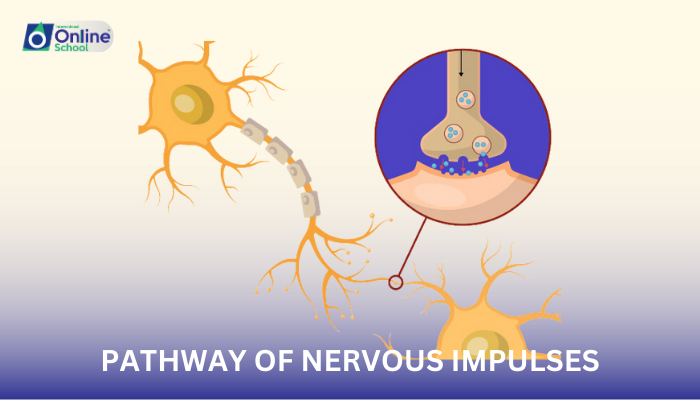
Reflex actions begin at sensory receptors that respond to a stimulus. The generated impulse travels along the sensory neuron towards the spinal cord. Inside the spinal cord, the impulse may pass directly to a motor neuron via a simple reflex arc, or it may be relayed through an interneuron for more complex reflexes. The impulse then travels out of the spinal cord along the motor neuron to the effector organ (typically a muscle or gland), triggering a response.
ii. Generation of Quick Responses
Bypassing the Brain: In reflex actions, the impulse does not need to be processed by the brain, which allows for a quicker response. The spinal cord serves as a simple but effective coordinator for such reflexes.
Protective Mechanism: This rapid response system is protective in nature, allowing for immediate reactions to potentially harmful stimuli without the delay of conscious thought.
iii. Efficiency of the Reflex Arc
Simplicity and Speed: The reflex arc is a highly efficient pathway, with few synapses (sometimes only one) that the impulse must cross, allowing for a very quick reaction.
Automatic Processing: The reflex arc is pre-wired for automatic processing, which means that the response is the same each time the reflex is activated.
In conclusion, the pathway of nervous impulses during reflex actions is a prime example of the efficiency and effectiveness of the nervous system. Reflex arcs allow for quick responses that can protect the body from damage, all without the need for conscious thought or direct brain involvement. Understanding this process is essential for appreciating how the body is equipped to handle immediate threats and maintain homeostasis through involuntary actions.
